
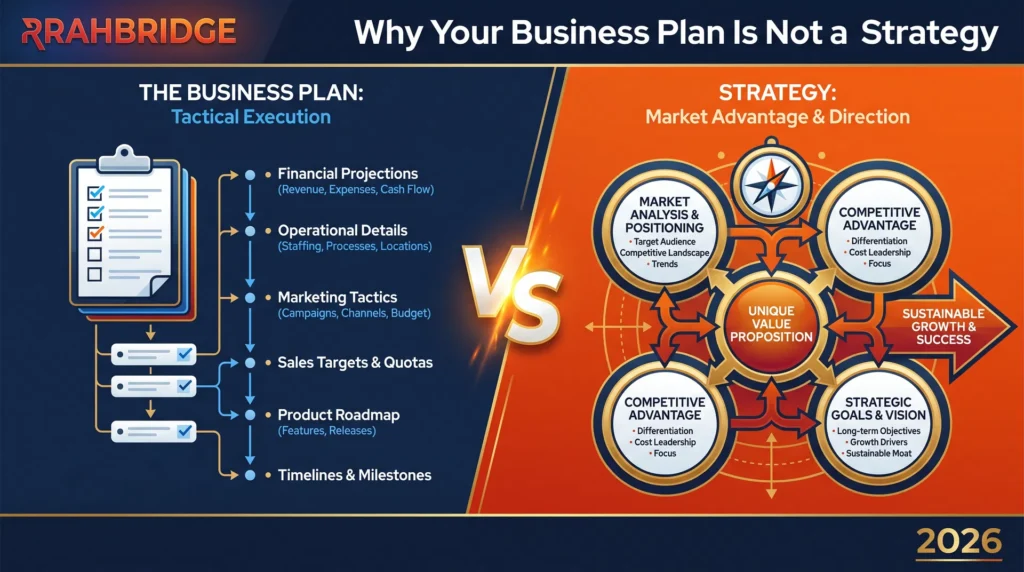
Why Your Business Plan Is Not a Strategy
Most SME founders spend weeks writing business plans that gather dust on a shelf. The reason? They have confused planning with strategy. Here is the difference, and what to do about it.
You finished the business plan. It took weeks. Fifty pages of market analysis, revenue projections, activity timelines, and resource budgets, all neatly bound. And then nothing changed. The plan sat there, impressive on paper but inert in practice.
This is the silent crisis facing the majority of small and medium-sized enterprises today: they have plans, but they do not have strategies. This distinction is not academic hair-splitting. It is the difference between a business that merely stays busy and one that actually wins.
The Expensive Confusion
Consider what happens in most SMEs when it is time to “do strategy.” The leadership team convenes. They compile a list of initiatives: improve customer experience, launch a new product line, hire more salespeople, invest in digital marketing. Each initiative sounds reasonable. None of them are obviously foolish. They get timelines, owners, and budgets. The document is labelled a strategic plan and filed away.
The problem? There is no internal coherence. No specification of how these activities collectively produce a competitive outcome that makes customers choose you over anyone else.
“Planning is quite comforting. Strategy is not — because it requires making choices that are genuinely risky.”
Roger Martin, Playing to Win
So What Is the Actual Difference?
Planning asks: What will we do? When will we do it? What resources do we need? Strategy asks a different and harder set of questions: Where will we compete? How will we win there? Why will customers choose us?
| Dimension | Strategy | Planning |
|---|---|---|
| Core Question | How do we win? | What activities will we execute? |
| Nature | Integrated set of choices | Sequence of actions and tasks |
| Focus | Competitive advantage | Resources, budgets, timelines |
| Comfort Level | Uncomfortable — involves real risk | Comfortable — you control the inputs |
| Failure Mode | Theory was wrong (adjustable) | Activities completed but no impact |
Why SME Founders Keep Making This Mistake
First, planning feels productive. Writing a business plan with detailed timelines gives a tangible sense of progress. Strategy, by contrast, feels abstract and uncertain. Second, strategy requires saying no. Every choice to compete in one area is a simultaneous decision not to compete somewhere else. Third, planning avoids blame. If you faithfully execute a plan and the results are poor, you can point to external factors.
A Framework That Actually Works
Roger Martin and A.G. Lafley developed the Strategy Choice Cascade — five integrated questions that form a coherent competitive approach. Under their guidance, P&G doubled its sales, quadrupled its profits, and increased its market value by over $100 billion.
- What is our winning aspiration? The purpose and motivating ambition of the enterprise
- Where will we play? The specific markets, segments, and customers you choose
- How will we win? Your distinctive value or cost advantage in that arena
- What capabilities must be in place? The core competencies required to deliver the win
- What management systems are required? The metrics and processes that sustain it all
The Bottom Line
A plan tells your organisation what to do. A strategy tells your organisation how to win. Both are necessary, but one without the other is dangerous — and the more common failure mode is having plans without strategy. What strategy requires is the courage to make real choices: to decide where you will and will not compete, to articulate a clear theory for why customers will choose you, and to align every aspect of your operations to that theory.
References
Martin, R. (2021). Strategy vs. Planning: Complements not Substitutes.
Harvard Business Review (2023). The Difference Between a Plan and a Strategy. HBR On Strategy Podcast.
Lafley, A.G. & Martin, R. (2013). Playing to Win: How Strategy Really Works. HBR Press.
U.S. Bureau of Labor Statistics. Business Employment Dynamics: Survival Rates of Establishments.