
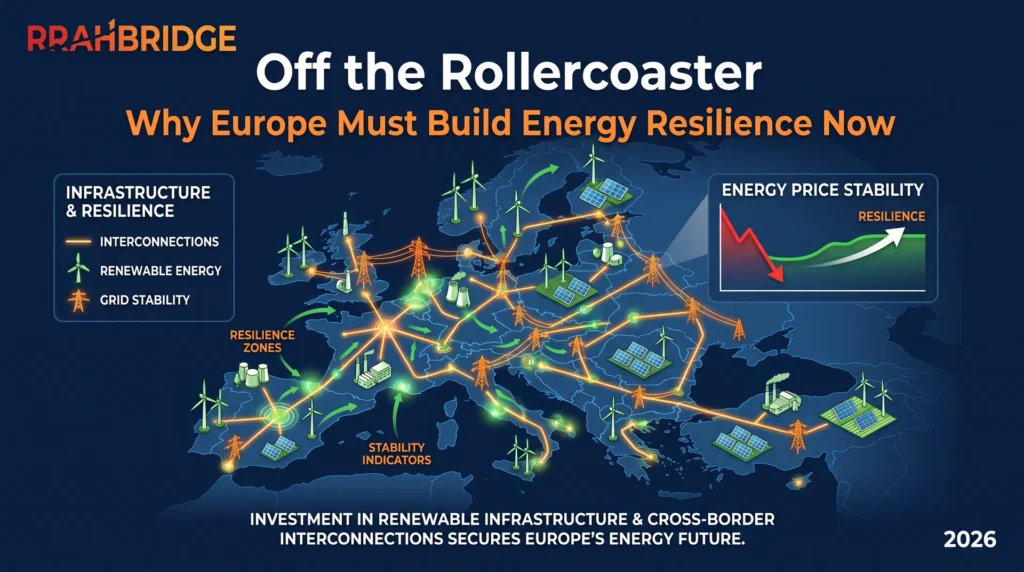
Off the Rollercoaster: Why Europe Must Build Energy Resilience Now
The Middle East conflict has exposed Europe’s dangerous dependency on imported fossil fuels. A strategic market analysis examining energy vulnerability and the path to sovereignty.
In February 2026, coordinated strikes against Iranian military infrastructure triggered events that reverberated through every energy market on the planet. Europe entered this crisis at its most vulnerable point — gas storage at just 46 bcm, compared with 60 bcm in 2025 and 77 bcm in 2024.
Ember calculated that in just the first ten days, the fossil price rise added an estimated €2.5 billion to Europe’s import bill. This means higher heating bills, costlier petrol, rising food prices, and diminished industrial competitiveness.
Europe’s Energy Dependency: The Statistical Reality
Nearly 60% of the EU’s energy needs are met by net imports. Oil imports account for 67% of all EU energy imports by value (2024), with EU oil import dependency above 93% since the 1990s. Natural Gas dependency has risen from around 50% in the 1990s to approximately 90% today. Norway, the US, and Russia together control 83% of all EU gas imports.
Between 2021 and 2024, inflated fossil fuel prices added approximately €930 billion to the EU’s import bill, according to Ember. The total fossil fuel import cost reached €1.8 trillion — more than double what it would have been at pre-crisis prices.
Untapped Domestic Resources
The North Sea: A Basin in Steep Decline
UK Continental Shelf production peaked in 1999 and has fallen approximately 75% to around 1 million boe/d in 2025. The UK has already extracted 86% of recoverable gas. The UK Government’s North Sea Future Plan (November 2025) confirmed no new exploration licences will be issued.
Renewables: Where Green Meets Security
Without the growth in renewables since 2019, the EU would have spent an additional €59 billion on fossil-fuel imports and imported an extra 92 bcm of gas. Almost 48% of EU electricity now comes from renewables. In 2025, solar and wind overtook fossil fuels as the EU’s primary electricity source for the first time.
Nuclear: Essential to the Equation
Nuclear power accounted for 23.3% of total EU electricity in 2024 — the single largest source of low-carbon electricity in the bloc. France alone produced 58.6% of all EU nuclear electricity. In 2024, 95% of France’s electricity was CO2-free, and the country exported a record 89 TWh to its neighbours.
UK-EU Collaboration: The Hamburg Declaration
On 26 January 2026, the UK and nine European nations signed the Hamburg Declaration — committing to 100 GW of joint offshore wind by 2050, enough to power approximately 143 million homes. The accompanying Investment Pact commits to 15 GW/year from 2031–2040, with industry pledging to cut costs 30% and mobilise €1 trillion of economic activity.
Lessons This Conflict Must Finally Teach
- Swapping one dependency for another is not a strategyThe EU-US trade deal committed the EU to $250 billion/year in US energy purchases — the exact concentration the bloc swore to avoid after the Russian experience.
- Energy policy is defence policyThe Nord Stream pipeline explosions of September 2022, confirmed as deliberate sabotage, demonstrated that subsea energy infrastructure in European waters is not immune to attack.
- Renewables are security infrastructureIn Spain, gas influenced electricity prices in only 15% of hours in early 2026. In Italy, it was 89%. Countries that deployed renewables aggressively are measurably more insulated.
- Speed matters more than perfectionEU gas demand has fallen 19% since 2021. But the IEA warns offshore wind projections have fallen approximately 25% due to policy changes, supply chain bottlenecks, and cost inflation.
“The Strait of Hormuz will reopen. Gas prices will settle. But the underlying vulnerability will persist until Europe builds an energy system that no foreign government, no distant conflict, and no narrow waterway can hold hostage.”
Sources & References
Eurostat — EU imports of energy products (2025/2026); Energy dependency rates
Ember — Shockproof (Nov 2025); Latest energy shock (Mar 2026)
GOV.UK — Hamburg Declaration (Jan 2026); North Sea Future Plan (Nov 2025)
Goldman Sachs Research — Iran conflict oil price impact (Mar 2026)
IEA — World Energy Investment 2024; REPowerEU progress analysis
RRAHBRIDGE Strategic Market Analysis, March 2026.