
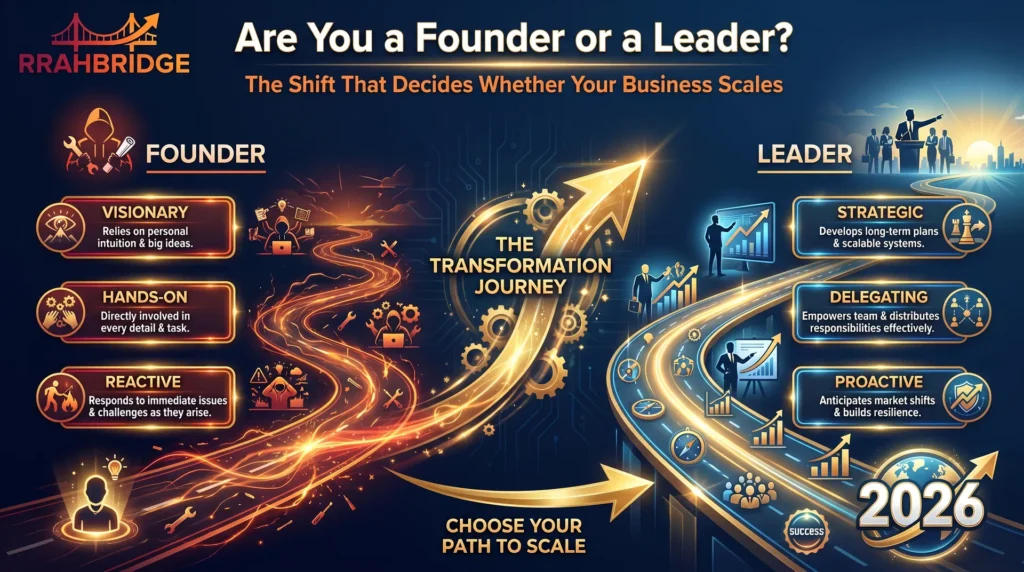
Are You a Founder or a Leader? The Shift That Decides Whether Your Business Scales
The skills that built your business will not be the ones that scale it. Here is how to make the transition from founder to leader.
Many SME founders are brilliant at what they do. They are the best doers in the room. They built the business from the ground up, wearing every hat, solving every problem, and making every decision. That intensity is what got the business off the ground.
But here is the uncomfortable truth: the skills that got you here will not get you there. As your business grows, the role it needs you to play changes fundamentally. Most founders are so deep in the doing that they never make the shift. The business does not outgrow the market. It outgrows the founder.
The Founder Trap
Research from Harvard Business School suggests that by the time ventures reach three years old, around half of founders are no longer serving as CEO. By year four, that figure drops to roughly 40%. Building a company and running a company are different disciplines.
The transition from founder to leader is one of the most difficult shifts you will ever make. It requires moving from doing to delegating, and from being the hero to being the coach.
Founder vs Leader: What Changes
- “I’ll do it myself, it’s faster”
- Makes every decision
- Solves today’s problems
- Holds all the knowledge
- Identity tied to output
- Team waits for direction
- “Who is the best person for this?”
- Designs decision frameworks
- Prevents tomorrow’s problems
- Builds knowledge-transfer systems
- Identity tied to team growth
- Team owns outcomes independently
Why Delegation Is Not the Same as Letting Go
Most founders hear “delegate more” and interpret it as “do less.” Delegation without structure is just abdication. The real shift is from being the decision source to being the decision enabler. McKinsey’s research found that the areas of business that a CEO directly controls account for roughly 45% of a company’s performance. The remaining 55% depends entirely on whether you have built a team that can execute without you in the room.
The Identity Problem
For most founders, the business is not just what they do. It is who they are. So when someone says “you need to step back from the day-to-day,” it does not feel like a promotion. It feels like a loss. Spencer Stuart’s research found that founders who successfully transition do so by redefining their value from “I do the work” to “I architect the system.”
Three Questions That Expose Where You Are
- If you disappeared for two weeks, would the business run smoothly? If the answer is no, you are still the operating system, not the architect of one.
- Does your team make decisions without checking with you first? If they always come to you before acting, you have trained them to depend on you.
- Are you spending most of your time on the “why” and “where,” or on the “how” and “what”? A founder lives in the how. A leader lives in the why and where.
Five Things to Get Right
- Let go of being the “best doer”Hire people better than you at their specific roles, and get out of their way.
- Build trust, not oversightTrust is built through clear expectations, consistent feedback, and genuine autonomy.
- Focus on the “Why” and “Where”The day-to-day execution should increasingly belong to your team.
- Design decision frameworks, not decisionsCreate frameworks that allow your team to make good decisions without you. This scales your judgment without scaling your hours.
- Invest in leadership development earlySupporting people through leadership development and coaching builds the bench strength your business needs to grow beyond you.
References
Harvard Business Review, “Leading After the Founder,” January 2026.
Gallup, “Engage Your Workforce by Empowering Your Managers First.”
McKinsey, “How the Best CEOs Build Lasting Stakeholder Relationships,” November 2024.
Spencer Stuart, “Transitioning from Founder-Led to Founder-Inspired.”