
LinkedIn: Your Network Size No Longer Decides Your Reach
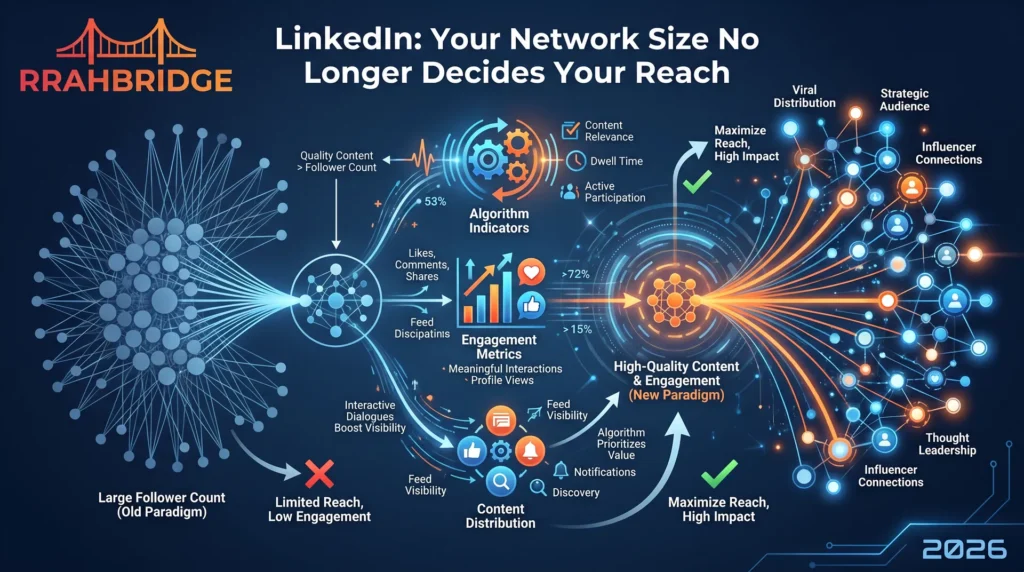
LinkedIn has replaced five separate discovery algorithms with a single LLM-powered system. The feed now prioritises topical expertise over connection count.
- Five separate retrieval pipelines
- Connection-based reach
- Historical engagement signals
- Keyword matching
- Network size as primary lever
- Single unified LLM architecture
- Semantic content understanding
- Evolving professional interests
- Topical relevance matching
- Expertise as primary lever
LinkedIn has officially overhauled its feed. On 12 March 2026, the platform’s engineering team published a detailed breakdown of a new recommendation architecture that replaces five separate discovery systems with a single system powered by large language models and GPU-accelerated infrastructure.
This is the most substantive technical overhaul of LinkedIn’s feed in the platform’s history. For the 1.3 billion professionals on the platform, the way content gets discovered has fundamentally changed.
What Actually Changed
The new system uses LLM-generated embeddings to understand what posts are actually about and how they connect to a user’s professional interests. Rather than matching keywords, it understands conceptual relationships between topics. The system also introduces a transformer-based ranking model that treats your feed interactions as a professional narrative over time, not isolated events.
“We’re rolling out a new advanced ranking system powered by LLMs and GPUs that better understands what a post is actually about and how it relates to a member’s evolving interests and career goals.”
Hristo Danchev, LinkedIn Engineering, 12 March 2026
Why This Matters for SME Founders
For years, the advice was to grow your network to increase your visibility. That advice is now outdated. Under the new architecture, your network size is a secondary metric. What matters is topical relevance.
- Expertise now travelsIf your content demonstrates deep, specific knowledge, LinkedIn will push it to relevant audiences who do not follow you and have never heard of you.
- Engagement-bait is being penalisedLinkedIn has stated the new system will actively reduce repetitive, click-driven posts. Automated commenting and shallow posts are losing reach.
- Quality outperforms volumeOne deeply insightful post on a specific business challenge will now outperform ten generic “thought leadership” updates.
There is also a profile-content mismatch risk. The new system cross-references your content against your profile, skills, and professional history. If your profile says you are a marketing consultant but your content is about cryptocurrency, the algorithm detects the mismatch and suppresses your reach.
What to Act On This Week
- Post from your actual expertiseAlign your profile, history, and content around your core professional domain.
- Go deep on fewer topicsA founder who posts consistently about one specific discipline will outperform one who scatters content across unrelated subjects.
- Stop optimising for likesThe system tracks dwell time, saves, and meaningful engagement. Surface-level reactions carry less weight than they used to.
- Upload video nativelyExternal links, including YouTube links, are deprioritised. Native video generates dwell time signals that the algorithm weighs heavily.
References
VentureBeat — How LinkedIn Replaced Five Feed Retrieval Systems With One LLM Model, Mar 2026
Social Media Today — LinkedIn Updates Its Feed Algorithm, 12 Mar 2026
Search Engine Land — LinkedIn Updates Feed Algorithm With LLM-Powered Ranking and Retrieval, Mar 2026