
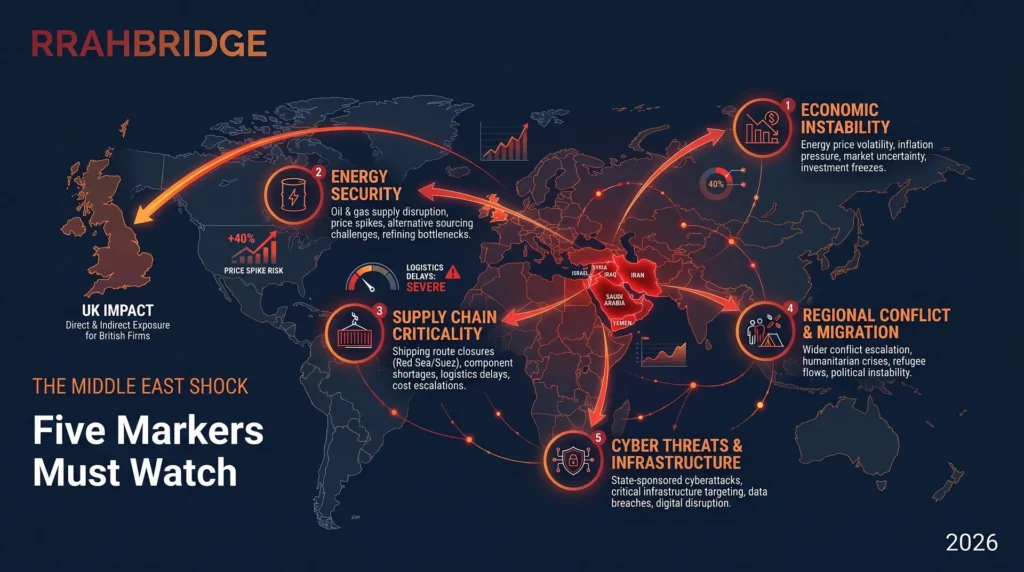
The Middle East Shock: Five Markers Every UK Business Must Watch Over the Next Three Months
A research-based analysis of how the Middle East conflict will impact UK businesses, assessed across five key markers: Oil, Natural Gas, Airspace Restrictions, Technology Transfer, and Trade.
The escalating conflict in the Middle East is no longer a distant geopolitical event. It is now an economic reality that UK businesses must confront head-on.
The FTSE 100 recorded its steepest single-day decline since November 2025, falling approximately 1.2% to around 10,780 points. The pound weakened below $1.34. Brent crude surged past $80 per barrel. The British Chambers of Commerce said disruption is inevitable if the conflict is sustained.
This article uses a structured, research-based framework across five distinct markers — Oil, Natural Gas, Airspace Restrictions, Technology Transfer Restrictions, and Trade — analysed against the latest available data from Bloomberg, BBC, Reuters, the OBR, ING, Rystad Energy, Verisk Maplecroft, KPMG, Logistics UK, and the ECIU.
Marker 1: Oil
Risk Level: HighBrent crude rose to around $78–$82 per barrel, a surge of approximately 8–10% since the conflict began. The Strait of Hormuz, through which roughly 20% of the world’s oil passes daily, has been effectively disrupted. Iran warned tankers against passage, at least 150 vessels dropped anchor outside the strait, and Saudi Arabia’s Ras Tanura refinery was shut down after an Iranian drone attack.
The AA warned that UK pump prices will inevitably increase. Rystad Energy stated that a sustained strait closure would directly impact UK consumers and business energy costs. For UK businesses in logistics, manufacturing, and retail, this means rising transport costs, higher raw material prices, and margin compression.
Marker 2: Natural Gas
Risk Level: HighEuropean natural gas futures surged more than 50% after Qatar halted LNG production. Qatar accounts for approximately 20% of global LNG supply. Asian LNG benchmark prices jumped nearly 39%. UK wholesale gas hit a 12-month high. The OBR’s adverse scenario modelling projected that a 75% increase in wholesale gas prices could push UK CPI inflation to a peak of 7.4% and trigger a recession lasting over a year.
Marker 3: Airspace Restrictions
Risk Level: HighAirspace closed across the UAE, Qatar, Bahrain, Iraq, Israel, Kuwait, and Iran. Dubai International, Abu Dhabi’s Zayed International, and Doha’s Hamad International — handling around half a million passengers per day — were shut down. Global air cargo capacity dropped 18% within 24 hours. The Global Cold Chain Alliance warned that pharmaceutical shipments face significant impacts due to longer alternative routing.
Marker 4: Technology Transfer Restrictions
Risk Level: Medium-HighThe EU Council extended the prohibition on exporting to Iran electronics, computers, telecommunications, sensors, lasers, navigation systems, and aerospace propulsion technologies. UK firms in technology, advanced manufacturing, and defence supply chains must review any stakeholders with actual or potential Iran exposure. The sanctions architecture now spans UN, EU, US, and UK measures, creating a multi-layered compliance burden.
Marker 5: Trade
Risk Level: HighCMA CGM suspended Suez Canal passage and rerouted vessels via the Cape of Good Hope. MSC suspended all cargo bookings to the Middle East. Maersk paused Trans-Suez sailings. Rerouting via the Cape of Good Hope adds approximately 10–14 days to Asia-Europe transit times. Higher shipping costs, increased insurance premiums, and longer delivery times are inevitable for UK importers.
How Should UK Businesses Prepare?
- Energy Cost ManagementReview energy contracts immediately. Lock in rates where possible. Build fuel cost increases into financial forecasting for Q2 and Q3 2026.
- Supply Chain DiversificationAudit exposure to Gulf shipping routes, Middle Eastern airspace, and Suez Canal transit. Identify alternative suppliers and routes now.
- Cash Flow ProtectionBuild a buffer. For firms with transport-heavy operations or energy-intensive processes, margin compression can happen quickly.
- Compliance ReviewReview sanctions compliance frameworks against the latest UN, EU, UK, and US measures if your business trades in technology, electronics, or dual-use goods.
- Scenario PlanningModel at least two scenarios: a short conflict (de-escalation within 2–4 weeks) and a prolonged conflict (3+ months with sustained disruption).
- Customer CommunicationIf you expect delivery delays or price adjustments, communicate early and transparently. Proactive businesses retain trust more effectively.
Sources & References
Bloomberg | Oil Prices Surge Further and Markets Slump | 3 March 2026
BBC | Oil and Gas Prices Jump as Conflict Escalates | 2 March 2026
ING THINK | War in the Middle East: Implications for Markets and Macro | 1 March 2026
Rystad Energy | Strait of Hormuz Closure Impact Analysis | 2 March 2026
OBR | Economic Implications of Further Instability in the Middle East | March 2024
Logistics UK | Fuel Duty and Supply Chain Resilience Statement | 2 March 2026
British Chambers of Commerce | Disruption Inevitable If Conflict Sustained | 2 March 2026
This article is for informational purposes only and does not constitute financial, legal, or investment advice.