Why Organic Marketing Is Not the Cheap Option
It is the strategic one. And most SMEs still have not worked that out. The commercial case for organic-first strategy, using IPA research, Binet and Field’s 60/40 rule, and a practical AIDA framework.
There is a persistent idea in small business marketing that organic is what you do when you cannot afford ads. Post a few things on social, stay consistent, and eventually something will happen. It is treated as the budget option, the waiting room before the real work begins. That framing is costing UK SMEs money they will never get back.
Organic marketing is not a consolation prize. Built deliberately, around a clear understanding of who you are trying to reach and what you want them to do, it is one of the most durable commercial assets a business can own.
What Proof Actually Looks Like
A founder in professional services begins posting on LinkedIn three times a week — not promotional content, but specific, opinionated takes on problems their clients face every day. After six months, the posts have modest reach. After twelve months, inbound enquiries begin. After eighteen months, those enquiries are pre-sold. The prospect has already read twelve posts, formed a view of how this person thinks, and arrived at a discovery call with trust already banked. No ad spend. No retargeting. No agency fees.
The Psychology Behind “I Tried It and It Didn’t Work”
If you press on what actually happened, the story is almost always the same. They posted without a system. They produced content for no defined audience. They measured the wrong things, saw low engagement, and concluded that the channel was the problem. The channel was not the problem. The absence of a strategy was.
Posting is not a strategy. It is an activity report.
What Most Agencies Will Not Tell You
The majority of agencies selling organic social management are selling posting, not strategy. Posting 20 times a month is not a strategy. It is a production service. It can be executed with no understanding of your audience, no connection to your commercial goals, and no ability to move a prospect from curiosity to conversion.
The IPA Evidence Base
The IPA Effectiveness Databank covers over 800 awarded campaigns from 1998 to 2024. Its most recent analysis found that campaigns which significantly build brand trust are 41% more effective at driving business growth than the average campaign. Trust-building campaigns reported customer acquisition rates of 39% against a 28% average.
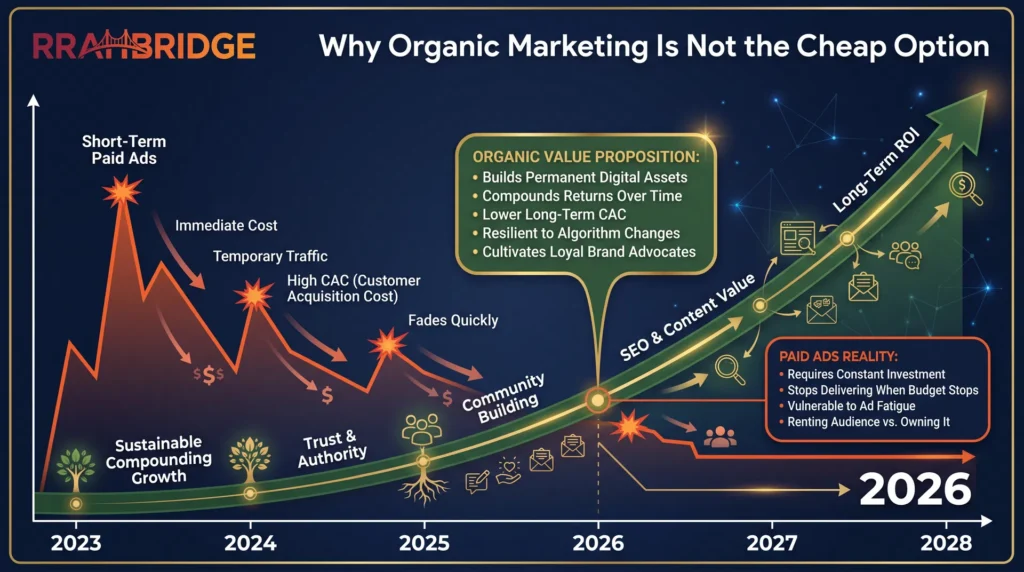
Binet and Field’s analysis of nearly 1,000 IPA campaigns established that the optimal budget split for long-term profit growth is 60% brand building to 40% sales activation. The most common SME mistake: investing close to 100% in short-term activation while spending nothing on brand. Performance harvests what the brand has sown. Without sowing, there is no harvest.
What an Intentional Organic Strategy Looks Like
Organic-first does not mean organic-only. It means building the foundation before spending on fuel. That foundation maps directly to the AIDA framework:
References
IAB UK & MTM (2023). SMEs’ trust in digital advertising increases by almost 50% vs 2020.
IPA (2024). Trust-building advertising delivers stronger business growth. Analysis of 812 campaigns, IPA Effectiveness Databank.
Binet, L. & Field, P. (2013). The Long and the Short of It. IPA.