
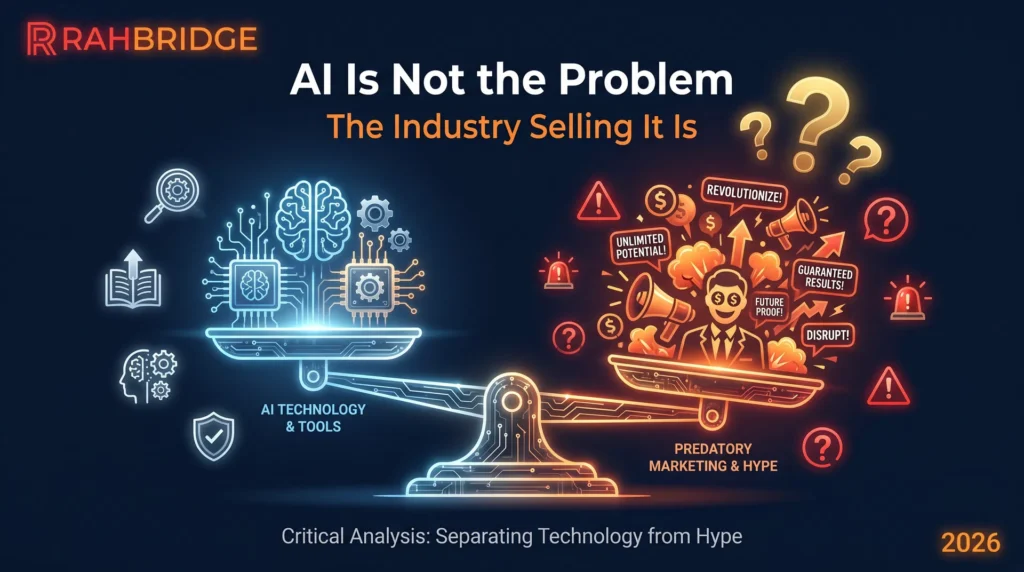
AI Is Not the Problem. The Industry Selling It Is.
The technology is improving faster than most people can track. But the market around it is creating more confusion than clarity. Here is what actually matters when adopting AI with intent.
Right now, AI is being presented in two extreme ways. On one side, it is positioned as the ultimate productivity engine that will change everything. On the other, it is framed as a threat that will replace jobs, skills, and even human relevance. Both views are incomplete.
Because if you actually use AI consistently, one thing becomes very clear: AI is not intelligence. It is amplification.
We Have Seen This Before — But This Time, the Speed Is Different
This is not the first time technology has created panic. When calculators were introduced, people feared the loss of mathematical ability. When the internet scaled, people questioned relevance and information overload. Yet what followed was not collapse. It was adaptation.
As highlighted in Gartner’s Hype Cycle, emerging technologies consistently move through a phase of inflated expectations before their real, practical value is understood. AI is currently in that phase. But the pace of improvement is unlike anything we have seen before — the gap between “interesting experiment” and “genuinely useful” has closed faster than most people expected.
The speed of AI is not the problem. The speed of confusion is.
AI Still Depends on One Thing: Human Input
Every output from AI starts somewhere. A prompt. A question. A direction. Remove that, and AI produces nothing meaningful. When Harvard Business School, Boston Consulting Group, and researchers from MIT and Wharton tested 758 consultants on realistic tasks, they found AI creates a “jagged technological frontier” — dramatically improving outcomes on some tasks while actively worsening results on others of seemingly similar difficulty.
Human judgement about when and how to use AI is not a legacy skill. It is the skill that scales with every improvement.
AI Is Being Mis-Sold
Alongside the hype, there is a quieter problem almost nobody is talking about. AI is being actively mis-sold. And the people paying the price are not the tech companies. They are the business owners, the freelancers, the founders who are trying to do the right thing and adopt AI responsibly.
- New tools launching daily, each claiming to be the one you cannot afford to miss
- Courses promising transformation in 30 days, taught by people who learned AI 60 days ago
- Subscriptions stacking up, each positioned as essential, none of them talking to each other
- “Experts” selling shortcuts that skip the foundations entirely
Forrester Consulting’s research into AI adoption barriers found that the biggest obstacles were not about access to tools. They were about infrastructure readiness, integration challenges, and the absence of a clear implementation strategy. The tools exist. The clarity around using them does not.
AI Does Not Need 20 Tools. It Needs Clarity.
A clear objective. What problem are you actually trying to solve? A defined use case. What specific task should AI handle? The right tool for that task. Not the most popular one — the most appropriate one.
The Real Risk Is Not AI. It Is Stagnation.
The World Economic Forum’s Future of Jobs Report 2025 makes the direction clear: the most valued workforce skills through 2030 are resilience, flexibility, agility, and the ability to keep learning. With 39% of core skills expected to change in that timeframe, the people who treat AI as a reason to stay curious will outperform those who treat it as a reason to panic.
AI is not here to replace humans. It is here to differentiate them. Those who learn how to think, adapt, and apply it with intent will become more valuable than ever.
References
Gartner, Hype Cycle for Emerging Technologies (annual)
Dell’Acqua, F. et al., “Navigating the Jagged Technological Frontier,” HBS Working Paper No. 24-013, 2023.
Forrester Consulting, “Biggest Barriers to Generative AI Success,” 2024.
McKinsey Global Institute, “Agents, Robots, and Us: Skill Partnerships in the Age of AI,” 2025.
World Economic Forum, The Future of Jobs Report 2025, January 2025.