
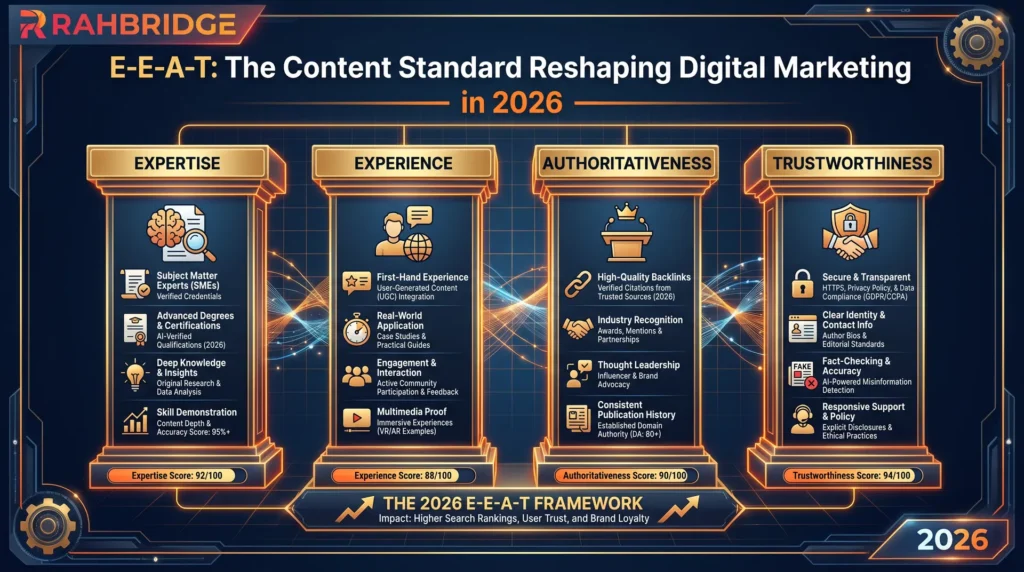
E-E-A-T: The Content Standard Reshaping Digital Marketing in 2026
Google embedded it into core ranking logic. LinkedIn rebuilt its algorithm around it. Meta and Instagram restructured their distribution systems to reward it. Here is what every marketer needs to understand this year.
E-E-A-T is not a new concept. It has existed within Google’s quality evaluation framework for years. But in 2026, something has shifted. What was once a signal monitored primarily by SEO specialists has become the content quality standard that every major digital platform is actively building around.
E-E-A-T is not a replacement for SEO. SEO covers technical performance, site architecture, keyword strategy, backlink acquisition, local search optimisation, schema markup, and much more. All of that still matters. What E-E-A-T represents is the content quality layer within SEO — the signals that determine whether technically sound content actually earns lasting authority and reach.
What E-E-A-T Actually Means
E-E-A-T stands for Experience, Expertise, Authoritativeness, and Trustworthiness. In December 2022, Google added the first E, for Experience — and the intent was clear: real-world, first-hand knowledge now matters more than polished presentation.
Experience
Has this person actually done the thing they are writing about? A marketing framework shared by someone with 15 years of client results lands differently than a recycled listicle. Algorithms are increasingly built to detect this difference.
Expertise
Deep, domain-specific knowledge demonstrated through specificity and nuance. Not broad generalism or ten tips that could apply to any industry. The specificity of your perspective signals whether you actually know your subject.
Authoritativeness
Are other credible sources and people referencing or engaging with your work? Authority is not something you declare. It is attributed to you by others — through backlinks, mentions, media features, and industry recognition.
Trustworthiness
Google states this is the most important of all four. Named authors, linked credentials, accurate sourcing, and a coherent professional identity all feed into this signal.
“Trust is the most critical component. The others contribute to trust, but content does not necessarily have to demonstrate all of them.”
Google Search Quality Evaluator Guidelines, December 2025
The Platforms Have Caught Up
LinkedIn rebuilt its algorithm around a 150-billion-parameter AI model (360Brew) that detects lexical diversity, profile-content alignment, and semantic depth. Generic posts are actively suppressed. Overall organic reach has dropped 50%, but creators posting authentic expert-level content are seeing stronger results than before.
Instagram / Meta declared 2026 “The Year of Raw Content,” explicitly prioritising authentic human content over AI-generated material. Meta removed 20 million inauthentic accounts in 2025. Accounts reposting 10 or more times in 30 days are excluded from all recommendations.
Google Search integrated the Helpful Content System into core ranking logic in its December 2025 Broad Core Update. Named authors, verifiable credentials, and content demonstrating real-world experience now carry measurably higher ranking weight across all industries.
The Opportunity Nobody Is Talking About
For the past decade, content volume was a competitive advantage. That era is ending. If you have 15 years of genuine experience in your field — if you have actually done the work, navigated the failures, developed real frameworks from real situations — you now have a structural advantage over any competitor who is outsourcing their voice or using AI to simulate expertise they do not possess. Your credibility compounds. Theirs does not.
What You Should Do Right Now
For Your LinkedIn Presence
- Audit your profile for alignment between stated expertise and recent content — 360Brew will find any gap
- Identify two to three topic areas where you have genuine, verifiable experience and commit to posting within those lanes for 60 to 90 days
- Replace generic content with specific content: real situations, named outcomes, frameworks you have actually used
- Two posts of genuine depth outperform five posts of recycled insight every time in the 2026 algorithm
For Your Website and SEO Content
- Every blog post needs a named author with a verifiable bio, not just “the team”
- Include first-person evidence: case studies, client outcomes, your actual experience with the topic
- Cite credible external sources and link to them — it builds trust signals and demonstrates research rigour
- Use schema markup for author and organisation to help search engines verify your entity-level credentials
References
Google Search Quality Evaluator Guidelines. December 2025 edition.
van der Blom, R. Algorithm InSights 2025 Report. LinkedIn.
Mosseri, A. Instagram Will Prioritise Raw, Real Human Content in 2026. December 31, 2025.
Google Search Central. Creating Helpful, Reliable, People-First Content. Updated December 2025.