
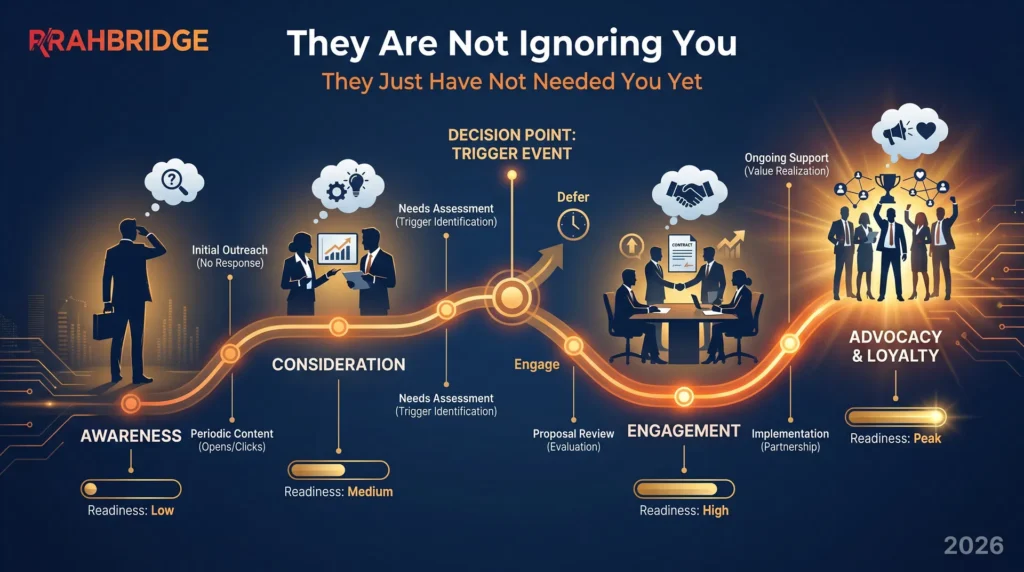
They Are Not Ignoring You. They Just Have Not Needed You Yet.
Why consistent reach beats ad spend as a default strategy, and what decades of consumer science actually says about when your next client will call.
Most businesses do not have a marketing problem. They have a patience problem. The content is going out, the brand is showing up, and somewhere out there a future client has seen it three times already. They just do not need you yet.
The immediate assumption when the phone is quiet: the marketing is not working. The more likely reality: the marketing has not been seen enough, for long enough, by the right people at the right moment. Those are very different problems. And confusing them is costing businesses real money.
The Memory Problem No One Talks About
When a potential client decides they need your product or service, they do not run an objective market analysis. They search their memory. Professor Byron Sharp of the Ehrenberg-Bass Institute spent decades studying how brands grow. His central finding: brands do not grow because people love them. They grow because people remember them at the moment they need to buy.
Sharp called this mental availability: the probability that your brand comes to mind when a buying situation arises. Every view, every impression, every piece of content that lands quietly builds one of those memory structures in the brain of a future buyer.
The mechanism has a name: Category Entry Points. These are the specific triggers — a pain point felt, a conversation had, a problem suddenly urgent — that cause a buyer to search their memory for solutions. The brands with the strongest memory structures at that moment are the ones considered. The ones not in memory are never evaluated at all.
Why Your Ideal Client Did Not Call Last Month
Most founders interpret silence as rejection. In reality, silence is almost always timing. Getting onto the shortlist is not primarily a function of ad spend. It is a function of consistent, repeated exposure over time, until your brand is embedded firmly enough in memory that it surfaces naturally when the Category Entry Point hits.
Kantar’s research found that consumers rely on mental shortcuts when making brand decisions. The effect is to choose the most salient brand.
This is why the founder who ran three months of heavy ads and stopped is often worse off than the founder who ran twelve months of lighter, consistent presence. The first built no lasting memory structure. The second became part of the shortlist.
The Mistake: Measuring the Wrong Thing
The issue is rarely that digital marketing does not work. It is that most SMEs run awareness activity whilst measuring it against direct response metrics, and declare failure when the phone does not ring in week four. Running an awareness campaign and measuring it on immediate sales is like planting seeds in October and declaring the soil barren in November.
Romaniuk and Sharp were specific about this: brand salience is not the same as brand awareness. Awareness is knowing a brand exists. Salience is the brand’s propensity to come to mind specifically during the purchasing decision. Salience is what drives the phone call. Awareness alone does not.
What the Neuroscience Confirms
ERP brainwave studies published in Frontiers in Neuroscience confirm the memory mechanism directly. When participants were shown brands with high awareness, their brains processed and categorised those brands faster and with less cognitive effort than low-awareness brands, even when the product quality was identical.
Every view that does not convert immediately is not wasted. It is banked. The return comes when the buyer is ready, not when the marketer is.
Three Questions to Ask This Week
- Are you measuring your awareness activity against awareness metrics — such as reach, frequency, and recall — rather than against direct sales figures?
- Have you been visible consistently enough, over long enough, for memory structures to form in your target market?
- Do you know which Category Entry Points your buyers experience, and is your brand present in those moments?
Research References
Sharp, B. (2010). How Brands Grow. Oxford University Press.
Romaniuk, J. and Sharp, B. (2004). Conceptualizing and measuring brand salience. Marketing Theory, 4(4).
Kantar BrandZ. Mental Availability and Brand Salience Research.
Frontiers in Neuroscience. The Influences of Brand Awareness on Consumers’ Cognitive Process: An ERP Study. 2020.